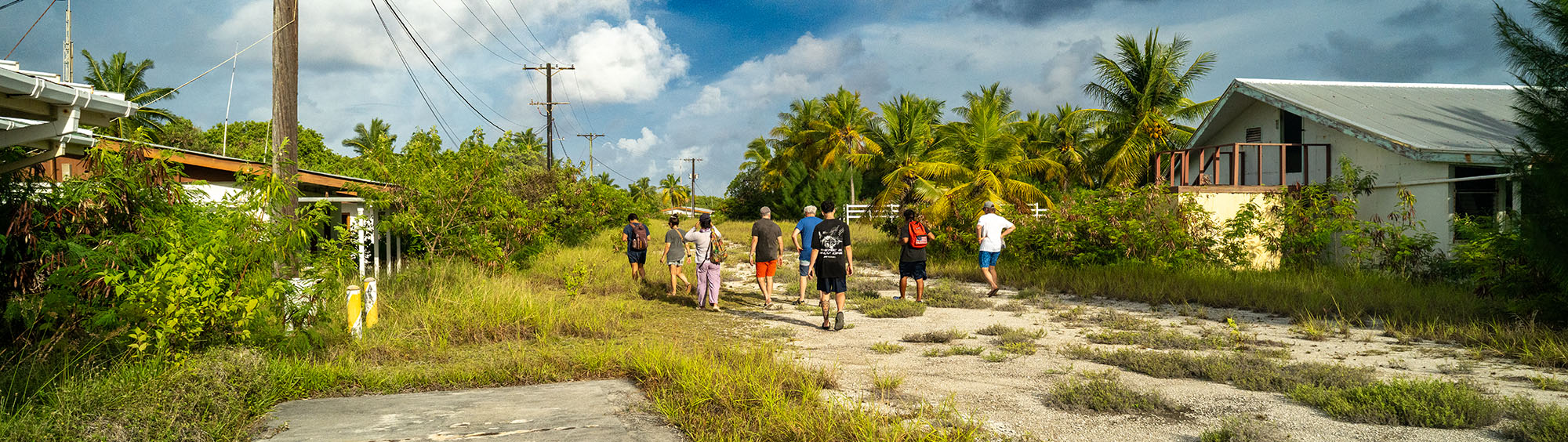
I first lived and worked on Bikini Atoll between 1996 and 1997, and came back again in 1999. It was a strange and hopeful time. Decades after the nuclear tests, the atoll was opening up to divers, and a small community of workers kept the island running: raked coral roads, painted houses, a council house, a little airport on Enyu Island with a sign that said welcome.
Nobody photographs a place thinking they are making an archive. You photograph the road because the light is good, the airport because you've just landed, the tank room because you're proud of it. Then thirty years go by, and those ordinary frames become the only record of how things were.
The welcome sign
The sign stood on two weathered posts, painted with palms, two shaking hands, and a line in Marshallese: men otemjej rej ilo bein anij, the national motto, meaning nothing is more precious than people for one another. It was later moved to the airport building on Enyu Island, and that is where it stands today.
The airport was where everything arrived: divers, supplies, news. In 1997 the ground around it was swept clean coral. In 2026 the bush has come right up to the walls. The sign is still saying welcome; there just isn't anyone left to say it to.
Main street
Same telegraph poles, same houses, same curve of road. The white fence is still standing in the 2026 frame if you look for it. What's gone is the white: the coral road that was raked every morning has turned back to grass, a line of scrub running down the middle like a seam.
At the crossroads stood the store: souvenirs, beverages, gifts, snacks, supplies, the sign said, with bicycles leaned against the porch and shipping containers out back. It was the island's shop, and its meeting place. In 2026 there is no crossroads left to stand at.
Where it began, underwater
Before the cylinders and the manifolds there were the people. Marshalls Dive Adventures, 1996: five of them on a boat with nothing behind them but open ocean, the crew that first took visitors down to the wrecks. Nobody in that frame looks like they are making history. They look like a crew that has just come off a good day. The log books record the dives, but the faces are only here.
These tank room photographs are from 1997, the first setup of the dive operation. Nitrox and helium, banks of cylinders, a Bauer compressor and a manifold on the wall: the beginnings of trimix diving on Bikini, and of the technical dive operation that would take people down to the fleet sunk in the 1946 tests. It's that operation at its very inception, before it had a reputation, before anyone knew it would work.
The second frame is the same building at the end of the day, divemaster Scott Herman on the porch, cylinders still stacked inside and visible through the louvres. Most of it was unglamorous work: filling, checking, logging. You photograph a light like that because it happens to be there, and only understand thirty years later that it also shows where the work was done.
The compressor room is the same story from the inside. The Bauer unit standing in its cage, the blending column against the wall, a bank of cylinders under pressure, bottles on the fill whip with names taped to them, someone at the manifold working the valves. Nobody photographs a room like that for the archive, the light through the open doors was simply good. Thirty years on, it is the clearest proof of how the diving was actually done, and of how early the operation was doing it.
The Council House
The Council House glowing under a 1997 sunset, the beachfront bungalow with nothing between its steps and the sea. Today the ferns are at the railings and you look out from the veranda into trees. An outrigger sits in the long grass, as if someone stepped away for a moment and the island quietly carried on without them.
Why the record matters
Bikini's history is usually told through a handful of famous images: the mushroom cloud, the sinking ships. The quieter chapters, the years when people tried to bring the atoll back to life, are far less documented. Some thirty years on, a box of slides is part of that record.
That's the case for documentation. Not as nostalgia, but as evidence. Places change, memories blur, and buildings get swallowed. A photograph taken carefully, dated and kept, lets historians, the Bikinian community and anyone who comes after see exactly what was there, and measure what's been lost.
The island will keep growing over its own history. The pictures are how we remember where the roads were.